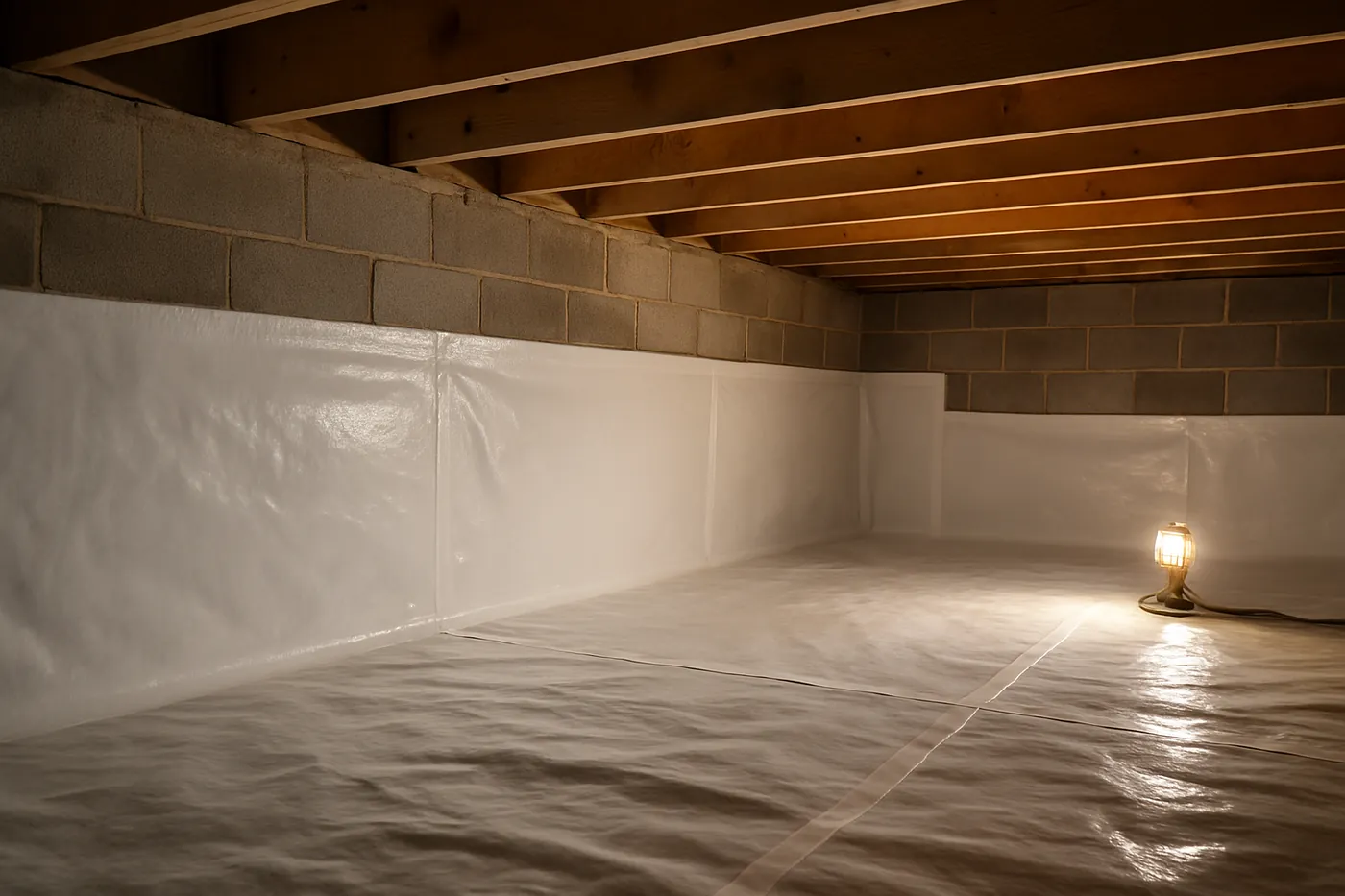
Appling mold removal mostly costs $1,500–$6,000, and $2,500–$9,000 when the crawl space needs the ground sealed and a drying system. On a rural lot, the ditch, culvert and drive work that stops the water can be priced as its own line.
Rural lots decide their own water
Appling spreads across larger properties where storm water goes wherever the land sends it. There is no engineered drainage on most of these lots, so driveways, culverts, and ditch lines determine whether about 44 inches of annual rain leaves the property or pools beside the house.
The recurring find is a culvert or ditch that silted in seasons ago. Nothing about the house is defective; the water simply started arriving somewhere new, and the crawl space has been absorbing it since.
What gets walked on a rural call
More of the property than a visit in town: where the land sheds water, whether ditch lines still function, what the drive is doing, and where any irrigation actually lands. A remediation performed while a plugged culvert keeps sending water at the foundation is money spent on a symptom. See inspection for what the visit covers.
Asked in Appling
There's no storm drainage out here. What can be done?
Quite a lot, and most of it is earthwork: restoring fall away from the house, re-cutting ditch lines that silted in, extending downspouts well past the foundation, and adding drainage where the lot traps water. It addresses the cause rather than the symptom.
My crawl space smells but looks dry. Why?
You are smelling what the space did last season. Stains, mineral lines, and fallen insulation record wet periods you were not there for, and in this climate a space can be actively humid without any standing water. A moisture meter reads the wood rather than the appearance.
Is there a charge to come out to Appling?
Ask about any travel charge when the specialist calls. Rural properties take longer because more of the lot gets walked - drives, culverts, ditch lines - so ask whether that changes the price of the visit.
A very small Census count
The Appling Census-designated place is tiny, with only about 290 homes in the 2020-2024 American Community Survey, so its percentages carry wide margins and the rural land around it is not counted in them. Within that count, the 1990s were the largest decade at roughly 40 percent, and close to half the homes predate 1980, mostly from the 1950s through the 1970s. Almost nothing was built here after 2000. Older rural houses on crawl spaces are the norm, which matches the culvert and ditch pattern above.
Kiokee Creek and Greenbrier Creek
The U.S. Geological Survey has gauged Kiokee Creek where US 221 crosses it at Appling, and Greenbrier Creek near Appling. FEMA has not done a detailed study of the streams around the community center; its map shows approximate Zone A flood areas along them, with the rest in Zone X. Approximate zones have no published flood elevation, so a low lot near either creek is worth looking up on the map before you decide where a crawl space drain should outlet.
County permits
Appling is unincorporated, so permits come from Columbia County, whose Development Services department includes Building Standards, Plan Review and Permits. Ask that office at (706) 868-3420 whether drainage or framing work on your property needs a permit.
Get an Augusta mold inspection
Tell us what you’re seeing or smelling: a musty smell coming up through the floor, cupping hardwood, condensation on ductwork, staining on a wall, and we’ll pass it to one independent local specialist for an inspection that includes going under the house. A local specialist serving Augusta calls you back.